Wednesday, March 26, 2025

GT: Mausoleum of Huangdi to be formally protected bylaw.:

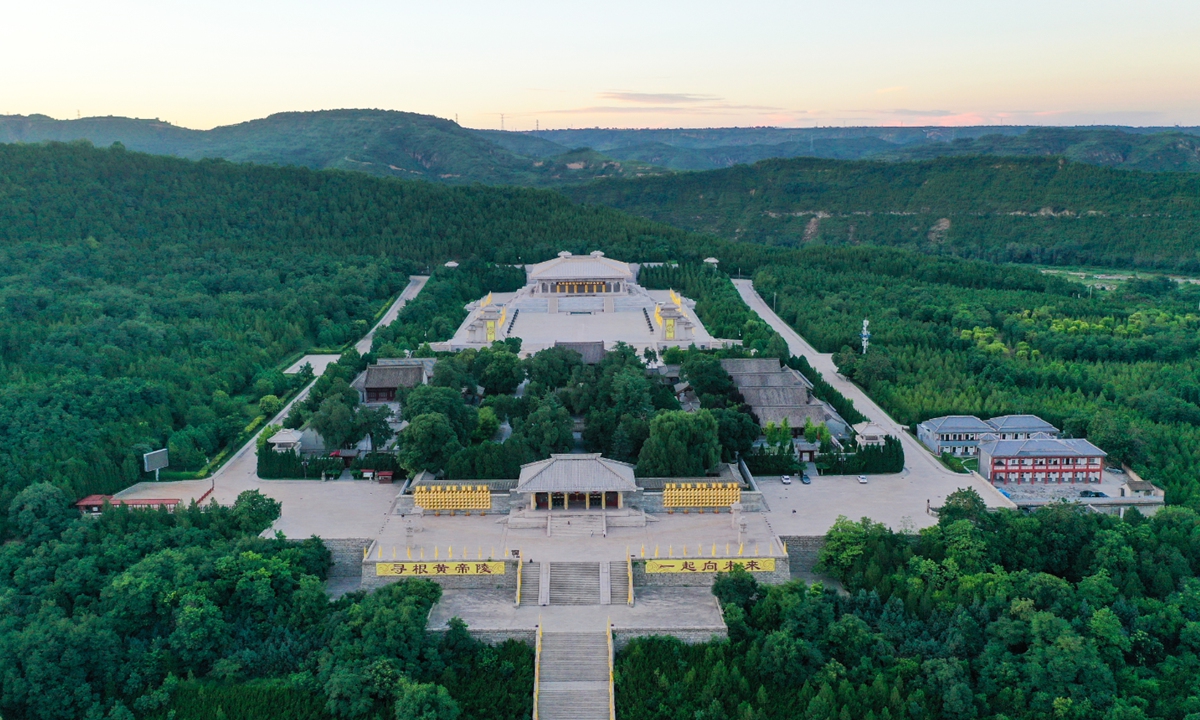
The Mausoleum of Huangdi in Northwest China's Shaanxi Province Photo: VCG
Amid the many public ceremonies being held across the Taiwan Straits honoring Huangdi, or the Yellow Emperor, scheduled for the upcoming Qingming Festival, or Tomb-Sweeping Day, a legal ordinance aimed at protecting the Mausoleum of Huangdi in Northwest China's Shaanxi Province is set to come into effect on April 1. This marks an advancement in the legal conservation of cultural relics related to Huangdi - one of the common ancestors of all Chinese people - and the spiritual symbols of the Chinese nation, according to the local legislation authority.
Advancing the legislative measures for the protection of the mausoleum is a crucial step in standardizing ceremonial worship practices, promoting Huangdi culture, fostering the integration of culture and tourism and strengthening the holistic and systematic protection of Chinese cultural and natural heritage, said Zhao Hong, an official at the Legislative Affairs Commission of the Standing Committee of the People's Congress of Shaanxi Province.
When speaking of the ceremonial activity that will be held at the mausoleum during a press conference on Wednesday, Chen Binhua, a spokesperson for the Taiwan Affairs Office of the State Council, stressed the importance of the mausoleum. He noted that Huangdi is the cultural ancestor of the Chinese nation, and his mausoleum serves as a spiritual symbol of Chinese civilization. The traditions of people from both sides of the Taiwan Straits to honor this ancestor hold significant importance for inheriting and promoting outstanding traditional Chinese culture, as well as for strengthening a sense of national identity, belonging and honor among the compatriots on the island of Taiwan.
The Mausoleum of Huangdi, located on Qiaoshan Mountain in Huangling county of Shaanxi, is regarded as the burial site of the legendary common ancestor of the Chinese nation. It serves as a place for descendants of the Chinese people worldwide to honor their roots and pay tribute to their cultural heritage.
The regulations in the ordinance expand the scope of the protections for the Mausoleum of Huangdi. In addition to safeguarding unearthed and above-ground cultural relics, they also include ancient trees, intangible cultural heritage such as Huangdi sacrificial rituals, as well as the surrounding historical landscape and natural environment within the protected area.
At the same time, the regulations also aim at promoting the innovative use of traditional cultural resources, encouraging the development of a cultural tourism IPs centered around the mausoleum and the creation of themed cultural and creative products, so as to further enhance the social impact of Huangdi culture.
Among the regulations, the management of the annual public worship ceremonies that are held during the Qingming Festival, is also included. This management emphasizes that the ceremony should be centered around the themes of tracing one's roots, and reflect the values of national rejuvenation, unity of the motherland and patriotism. Public worship activities should be conducted with solemnity, dignity, and grandeur, while also being frugal.
More than 350 representatives will attend the mausoleum's 2025 ceremony to pay homage to the emperor, Feng Haobin, a deputy director of the management committee of the mausoleum, introduced at a press conference on Tuesday.
The ceremony consists of nine procedures, including offering flower baskets, reading a memorial address with reverence and planting cypress trees. Within the mausoleum, there stands an ancient cypress tree that is believed to be more than 5,000 years old and thought to be planted by the emperor himself. Planting such trees has since become a tradition during the ceremony.
Zhang Yiwu, a professor of cultural studies at Peking University, told the Global Times that the "special cultural connotation" of the mausoleum has made the recent conservation regulation particularly meaningful.
Unlike other cultural or archaeological heritage sites, the mausoleum is a symbol of the "cultural origin of early Chinese civilization," Zhang said. Due to the symbolic nature of the site, conservation regulations should be expanded to not only include the site's building, but other aspects related to "the site's value, public education function and environment."
"Such an expanded conservation scope helps cultural heritage sites build an all-round conservation plan that can act as a prototype for other sites," Chen Xin, a manager at the Temple of Fuxi, told the Global Times.
Similar to the Mausoleum of Huangdi, the Temple of Fuxi is dedicated to the mythological figure Fuxi, who is widely considered as the primordial ancestor of the Chinese humanities.
GT: Friend or Foe: How US backstabs its allies under America First logic.. Part One
The US government recently designated South Korea as a "sensitive country," which was described by some South Korean media outlets as "an unexpected move." "This decision not only damages South Korea's international reputation, but also raises serious questions about the state of diplomatic coordination between Seoul and Washington," read an opinion piece published by The Korea Herald on March 20. How did one of America's closest allies end up on this list, and what should be done to reverse this designation? the article asked.
In recent years, the US has made frequent policy changes in its global strategy, leading to rifts in its relations with traditional allies. From Europe to Asia, several of its allies have experienced being "stabbed in the back" by the US even at critical moments, which has drawn widespread attention from the international community and raised concern among the affected allies.
What does it mean to be an ally of the US? Are these allies receiving the promised benefits, or are they, in fact, more pawns of the US' strategic game? The Global Times is launching a two-part series that focuses on the dilemmas faced by US allies under its hegemony. This is the first installment.

Beth Calder sorts packages at Point to Point Parcel, on March 17, 2025, in Point Roberts, Washington, the US, near the Canadian border. Calder's shipping and receiving business mostly caters to Canadians and has seen a significant downturn this year. Photo: VCG
Former US secretary of state, Henry Kissinger, once quipped that "it may be dangerous to be America's enemy, but to be America's friend is fatal." This may be how South Korea feels at the moment.The US Department of Energy confirmed earlier this month that it had designated South Korea as a "sensitive" country in January, CNN reported on March 18. This designation making South Korea "the only on the list [of sensitive countries] with which Washington has a mutual defense treaty," reported The Korea Times the following day.
South Korean media outlets analyzed that this move may lead to possible new restrictions on scientific and technological cooperation between the two countries. To "swiftly" address the highly charged issue, South Korea and the US began working-level talks on last Friday, Seoul's Industry Minister said, as reported by The Korea Times on Sunday.
The US Department of Defense also announced on Friday that Secretary of Defense Pete Hegseth will depart next week for a trip to Hawaii, Guam, the Philippines and Japan. This will be Hegseth's first official visit to the so-called Indo-Pacific region during his tenure. Unlike traditional first trips to the Asia-Pacific region by US defense secretaries, which typically include South Korea, Hegseth has notably omitted South Korea and included the Philippines instead.
South Korea is not the only US ally that has found itself in crisis given that similar "backstabbing behavior" of the US toward its allies has happened in the recent past. From the tariffs on EU, Canada, to exerting pressure on Japan and South Korea over security issues, these tactics have left US allies feeling uneasy.
The extensive "backstabbing behaviors" by the US stems from its "America First" logic, which fundamentally serves the interests of the US itself, according to Xiang Haoyu, a research fellow at the China Institute of International Studies.
In the context of its hegemony, the alliance relations between the US and its allies are never equal relations. The comprehensive national power of the allies in military, political, economic, and security aspects is disproportionately lower compared to that of the US. This disparity determines that the US holds a dominant and controlling position in the alliance relations. When it comes to dealing with allies, different US administrations may employ various tactics, but the essence remains the same-to sustain the US' hegemony and serve its own interests, Xiang noted.
Allies, but 'America First'
The alliance system of the US was formed during World War II and consists of two different frameworks. One is a collective alliance system mainly in Europe, where many countries join a multilateral structure such as NATO. Another is bilateral relationships mainly in the Asia-Pacific region. In either system, the core of becoming an ally of the US lies in the establishment of a mutual defense pact, meaning that if one country is attacked, the other signatory is also considered to be under attack and is obligated to assist in retaliating against the aggressor, according to Xiang.
A mutual defense pact obligates the US and its allies to defend each other in face of military attacks, but does not necessarily exempt these allies from the US' underhanded tactics, especially under the "America First" approach of the Trump administration.
For example, the US' allies in the North Atlantic Treaty Organization (NATO) have, in the recent past, been questioning their alliance relations with the US after the Trump administration threatened not to defend a fellow NATO member that is attacked if the country fails to meet the 5 percent spending threshold of its GDP on defense, which is more than any NATO member currently spends.
If the US really does so, it would mark a significant shift from a core tenet of the alliance known as Article 5, which states that an attack on any NATO country is an attack on all of them, according to NBC news.
The Trump administration has expressed interest in acquiring Greenland, a territory of Denmark, a founding member of NATO, since his first term, emphasizing its significance for American economic security. The administration even suggested that they might impose tariffs on Denmark if the country were to reject his proposal to purchase the island.
Almost half of Danish people now consider the US to be a considerable threat to their country and the overwhelming majority oppose Greenland leaving to become part of the US, The Guardian reported, citing new polling by YouGov.
Canada is another close ally and major trading partner that had recently swallowed the bitter pill of the US' "America First" approach after the Trump administration announced in early February that it would impose a 25 percent additional tariff on imports from the country, along with with Mexico and China.
Mark Carney, Canada's next prime minister, promised his government will keep Canada's tariffs on "until the Americans show us respect." "We didn't ask for this fight, but Canadians are always ready when someone else drops the gloves... So Americans should make no mistake. In trade, as in hockey, Canada will win," he said in his first speech after being elected as the new Liberal leader on March 9.
The intense back-and-forth between the US and Canada serves as a testimony of the ramshackle unity of another decades-long US alliance, naming Five Eyes that is made up of the UK, the US, Canada, Australia, and New Zealand.
However, the Prism surveillance scandal exposed in 2013 dealt a heavy blow to the Five Eyes alliance. European media outlets revealed that the US had used Denmark's secret service to spy on the leaders of many European countries including former German chancellor Angela Merkel, sparking widespread outrage.
Profit from suffering 'friends'
Ultimately, what the US seeks is comprehensive superiority over all other countries, including its allies, Chinese analysts pointed out.
In January, then Biden administration officially blocked Nippon Steel's proposed $14.9-billion purchase of US Steel, dealing a probable fatal blow to the contentious merger plan after a year of review, the Business Times reported.
Biden claimed that "a strong domestically owned and operated steel industry represents an essential national security priority and is critical for resilient supply chains," according to the Business Times.
According to the Business Times, Nippon Steel had been actively making efforts, even concessions, to ease the approval of the deal, including offering to move its US headquarters to Pittsburgh, where US Steel is based, and promised to honor all agreements in place between US Steel and the United Steelwokers, the industrial union in the US. The company had also reportedly proposed giving the US government veto power over any potential cuts to US Steel's production capacity.
Japan's Industry Minister, Yoji Muto, described the Biden administration's decision to block the deal on the grounds of concerns over national security as "incomprehensible and regrettable," Kyodo News reported in January.
The US has also repeatedly irritated its European allies by profiteering from the Ukraine crisis.
Europe soaked up most of the US' liquefied natural gas (LNG) exports for the second straight month in February 2025, as cold weather and high prices pushed up demand for superchilled gas across the Atlantic, Reuters reported on March 3, citing preliminary data from financial firm LSEG.
According to Reuters, in February, 6.82 million metric tons (MT) of LNG, or 82 percent of the total 8.35 MT LNG exported from US plants went to Europe. The Dutch Title Transfer Facility (TTF) benchmark in Europe averaged $15.28 per million British thermal units (mmBtu) in February. That contrasts with $8.12 per mmBtu in February 2024 and an average of $10.95 per mmBtu for 2024.

Picture shows the shelves of a supermarket are empty of eggs for sale and a limit of only one dozen per customer on March 23, 2025, in New York City, the US. Photo: VCG
Eating its own bitter fruits
After World War II, the US stood tall among nations, attempting to dominate the world. The outbreak of the Cold War forced it to adjust its global strategy and begin courting allies. The core of this strategy was to promote the economic revival of allied countries, forming a strategic alliance centered on the US, spanning the Atlantic and Pacific Oceans. This aimed to gain a strategic advantage over the Soviet Union in the global balance of power, according to Xiang.
The US primarily makes judgments and decisions in international relations based on its own interests, particularly in the cost-benefit analysis of its alliances, he noted.
Xiang noted that the US' repeated "betrayal behaviors" in recent years made its ally system crumble under the banner of "America First," revealing to the world the selfish and hypocritical nature of the US.
Take Japan as an example. Commenting on the Nippon Steel issue, Chen Youjun, a researcher at the Shanghai Institutes for International Studies, said that the issue would naturally prompt a strategic rethinking in Japan about whether the US is truly an ally that can be trusted. Is there really a mutual trust that underpins the Japan-US alliance?
The US is eating its own bitter fruits. According to The Economic Times, Poland, Finland, and Denmark declined the requests from the US to export eggs as Americans face surging egg prices.
The request coincides with a raft of new US tariffs on several countries, including those in Europe, and the threat of more. It exposed the US' double standards of being "partners when needed, burdensome when not," Xiang said.
There is an old saying in China: "Those who follow the right path gain more support, while those who stray from it receive little help." When US' allies repeatedly face betrayal, who would still be willing to stand with and fight for Uncle Sam?
Tuesday, March 25, 2025
GT: US-Philippines military ensemble tailored stir up geopolitical tensions.
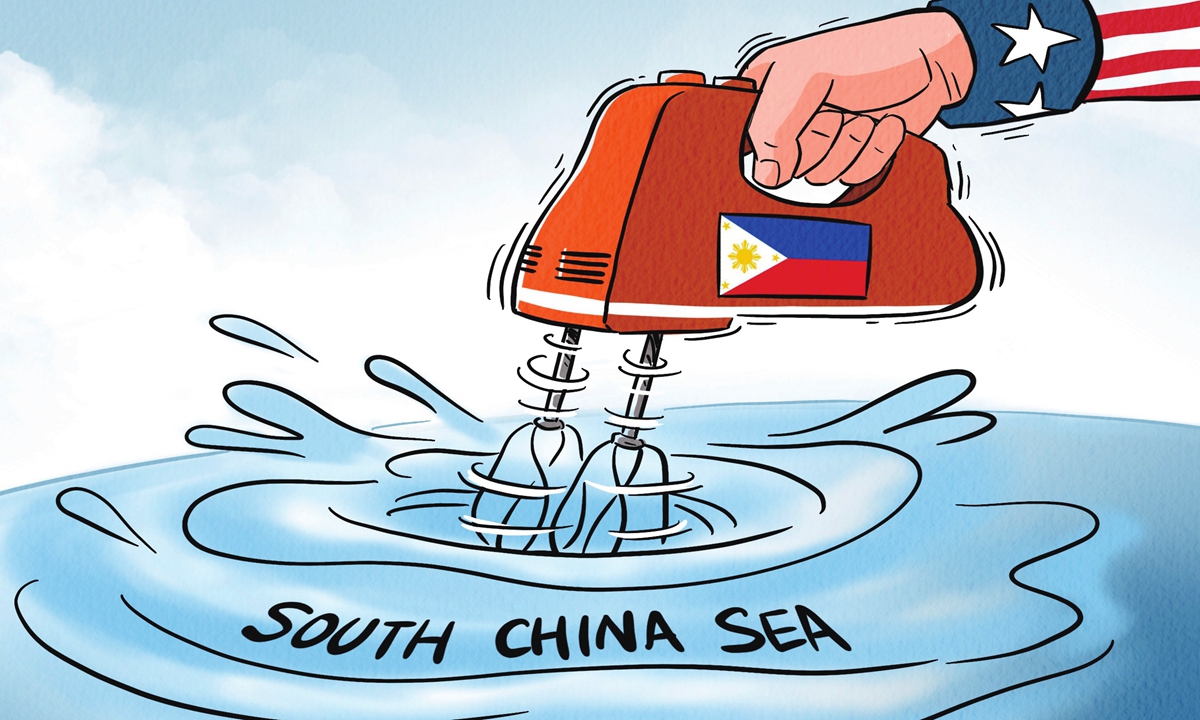
Illustration: Liu Rui/GT
Recently, the Philippines has been leveraging external partnerships to heighten tensions in the South China Sea. After the joint air patrol, it conducted a multilateral maritime cooperative activity. These military "ensembles," presented in the name of demonstrating security commitments and maintaining the rules-based order, resemble an orchestrated display of military posturing — with dangerous sparks repeatedly ignited by Manila flickering within.
The US-Philippines show of allied power in the South China Sea serves as a calculated demonstration centered on the so-called security issues, carrying specific symbolic meanings. First, it emphasizes that the US-Philippines security alliance remains strong, and that the US' "security commitment" to the Philippines should be realized through joint maritime actions, rather than merely remaining on the phone line between the Filipino foreign minister and the US Secretary of State. Second, it demonstrates to the US allies and partners in the Asia-Pacific region that bilateral and minilateral military security cooperation remains active and operational. In a sense, the US-Philippines joint patrols in the South China Sea have turned into mobile billboards showcasing the credibility of major external powers' alliances.
While stoking tensions at sea, the Philippines still frequently exaggerates the so-called China threat. This political manipulation is crystal clear in its intentions.
From the Philippine Department of Justice's reckless call for a new South China Sea international case, to the Philippine Department of National Defense's unfounded accusations of Chinese warships passing through the Basilan Strait, to the National Bureau of Investigation stirring up claims of "Chinese spies," these statements are not based on genuine security concerns, but function as political leverage for domestic politics. A think tank member in Manila once told me: "True security is not gained by courting external powers. The current discussions of security issues in Philippine politics have become a fixture of the election season."
From bilateral air patrols to joint maritime patrols, the carefully selected aerial shots and covert sailing routes are less about military deterrence aimed at China, and more about the Philippines curating a theatrical narrative tailored to stir up security issues in the public discourse.
Afterwards, in their sanctimonious statements, the US and Philippines deliberately replace the internationally accepted term South China Sea with the West Philippine Sea. This is not only a geographical term substitution but also a form of "boiling the frog in the warm water" in the realm of cognition. This discourse strategy mirrors the legal packaging of the 2016 South China Sea arbitration award — where China's Nansha Islands were fragmented into individual islands and reefs in legal terms, the islands, reefs and shoals in the Nansha Islands were referred to as "maritime features," and overlapping waters were framed as "Philippines' exclusive economic zone." Such systematic discourse transformation is an attempt to create a psychological suggestion of legitimate existence in the international public opinion arena.
All of this reinforces the Philippines' perception that it has received political and diplomatic support from the US and its allies, giving it more confidence. However, from the statements of the spokesperson of the Chinese People's Liberation Army (PLA) Southern Theater Command, it is evident that every little provocation in the South China Sea is fully under control, and the PLA will not allow the Philippines to run rampant in the region. It will take appropriate countermeasures when necessary. During the Chinese New Year, China's air and naval forces, as well as the China Coast Guard, maintained combat readiness patrols and law enforcement patrols in the South China Sea. This no respite during the holidays posture itself is the most vivid form of diplomacy.
Unlike the deterrence logic of certain countries, China's naval forces' routine presence at key islands, reefs and critical waters in the South China Sea is more like the basic move in a game of Go — focusing on long-term strategic positioning rather than short-term spectacle, but by accumulating strategic momentum through daily legitimate rights protection. Now, the South China Sea game has entered the marathon mode, where the competition is about strategic patience and comprehensive strength.
When the US-Philippines-led bilateral and multilateral joint patrols turn into a military carnival, and when Philippine President Marcos ties the presence of the Typhon system in the Philippines to the South China Sea issue, a real danger is no longer about how far the missiles can reach, but how quickly the range of policy rationality is shrinking.
Undoubtedly, the US-Philippines military adventurism will increase the risk of misunderstandings, misjudgments, and accidental clashes, reinforcing the reality that external interference and Philippine actions are fueling instability, undermining peace and stability in the South China Sea and stirring up regional confrontations.
The author is a director of Research Center for International and regional studies at National Institute for South China Sea Studies. opinion@globaltimes.com.cn