Monday, September 8, 2025

GT: China's Ministry of State Security discloses espionage case involving overseas individuals disguised as charity workers. Tues 09-09-2025

CHINA / SOCIETY
China’s Ministry of State Security discloses espionage case involving overseas individuals disguised as charity workers
Published: Sep 09, 2025 08:32 AM
Photo: China’s Ministry of State Security

Photo: China’s Ministry of State Security

China’s Ministry of State Security on Tuesday revealed that a foreign organization sent operatives into remote southwestern regions in China disguised as mountaineers and charity workers, where they posed as providing medical aid to gain villagers’ trust and recruit guides to illegal investigate into local politics, economy, geographic resources, and social governance.

Investigations found that an individual surnamed Xia from the overseas organization had received specialized training from an institution linked to a foreign defense ministry, covering emergency response, battlefield survival, cross-country swimming, and GPS mapping. Xia also maintained close ties with overseas investigative and consulting firms, focusing on China’s political trends, defense, military affairs, and territorial interests, according to an article released by the Ministry of State Security on its WeChat account. 

Xia repeatedly instructed associates to use advanced surveying equipment to infiltrate areas near Chinese military zones, conduct illegal mapping, and transmit the data abroad in encrypted form. After a detailed investigation, China’s national security agencies gathered solid evidence of Xia’s unlawful activities and took action in accordance with the law, said the article. 

The ministry noted that according to China’s Counter-Espionage Law, espionage activities carried out by foreign institutions, organizations, or individuals, or those they instigate or finance others to carry out, as well as espionage activities carried out in collusion between domestic institutions, organizations, or individuals and foreign counterparts, shall all be subject to legal liability. Espionage constituting a crime shall be subject to criminal prosecution in accordance with the law.

Also, China’s Law on the Protection of Military Installations strictly bans unauthorized personnel, vehicles, or vessels from entering land or water military restricted zones, and prohibits aircraft from flying at low altitudes over such areas. 

It also forbids photographing, filming, recording, surveying, mapping, positioning, sketching, or otherwise documenting military restricted zones without approval from the relevant military authorities. Any disclosure of state secrets related to military facilities — or acts of stealing, probing, purchasing, or illegally providing such secrets to foreign entities or individuals — constitutes a crime and will be prosecuted under the law.

GT: Exclusive : China-Brazil ties expand beyond economy co-op to strategic dimensions, says special advisor to Brazilian President. Wed 9th SEPT, 2025


IN-DEPTH / DIPLOMATIC CHANNEL
Exclusive: China-Brazil ties expand beyond economy co-op to strategic dimensions, says special advisor to Brazilian President
Ushering growth through friendship
Published: Sep 08, 2025 08:52 PM
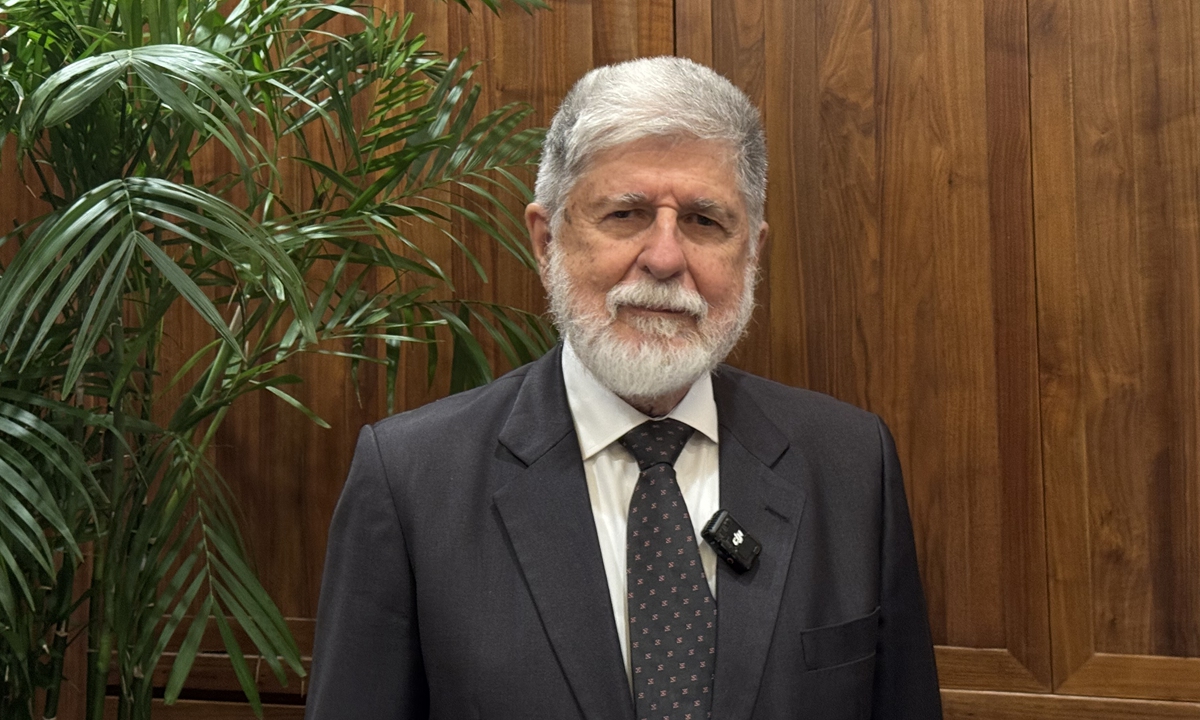
Celso Amorim, chief advisor to the President of Brazil Photo: Zhao Yusha/GT

Celso Amorim, chief advisor to the President of Brazil Photo: Zhao Yusha/GT

China-Brazil relations have expanded beyond traditional economic and trade cooperation to encompass political and strategic dimensions, with broad space for collaboration in jointly safeguarding multilateralism and promoting a fairer international order, Celso Amorim, chief advisor to the President of Brazil, told the Global Times in an exclusive interview.  Amorim, who visited Beijing to attend the commemorations of the 80th anniversary of victory in the Chinese People's War of Resistance against Japanese Aggression and the World Anti-Fascist War, noted that bilateral ties are now at their "best period in history," and he himself has been a witness to this rapid development.   

When asked about the recent tensions between Brazil and the US, Amorim said Brazil does not refuse dialogue with Washington on tariffs and other issues. However, he emphasized that so far, the US has not shown Brazil sufficient respect, which makes negotiations very difficult. "We do not accept any externally imposed pressure - this is the greatest challenge in current Brazil-US relations," he said. 

"Unfortunately, some in the US still see Brazil as their 'backyard.' But we are not anyone's backyard; we want to be a partner. Whether dealing with the US, Europe, or China, we hope to engage as equal partners."

GT: You participated in China's V-Day military parade on September 3. What was your impression? 

Amorim:
 I was struck by the force and the importance of the parade, the very modern armament, including for cyberwar, and all these new things.

But what impresses me the most is when you look at it historically, and you see how much China has changed completely in 80 or 100 years. China was a country that was attacked by other countries without a defense capacity. Now, I think the parade clearly showed that it's one of the strongest countries in the world. 

But I think the best thing about the parade was to see the pigeons in the end. Because that really showed that the objective is peace, and not to invade or go against anyone, but to be prepared for anything  and create an equilibrium in the world order.

GT: During the phone call between the two heads of state, Chinese President Xi Jinping said that China-Brazil relations are at their best in history. How do you interpret "the best"? Has China-Brazil cooperation expanded beyond the traditional economic and trade fields into broader political and strategic areas?

Amorim:
 It's true. President Luiz Inacio Lula da Silva and President Xi Jinping have maintained close interactions, with Lula having visited China twice during his current term. In the field of economic relations, China is our biggest trading partner today, and also together we issued a six-point consensus on our common understanding of the political settlement of the Ukraine crisis.  

We are working together on this idea of building a community with a shared future for mankind, but we also have the expressions for a world that should become more just and a planet that is more sustainable, because these are two preoccupations of Brazil, which China also accepted. We also hope to have the presence of China in the COP30, to chair climate change talks.

China and Brazil are the largest developing countries in the Eastern and Western Hemispheres, respectively. I think it's a very broad cooperation in many areas. I myself am also a witness to the continuous development of this relationship.

GT: Now there are many Chinese companies like BYD and Temu that have entered the Brazilian market. The Brazilian market has also been described by many Chinese companies as "the last blue ocean." Does Brazil welcome more Chinese enterprises? What new measures will be taken to facilitate China-Brazil economic and trade cooperation?

Amorim:
 It's a big success. When I take a taxi I use Uber, and most of the new cars are Chinese-made. But I think it's good that those factories are now in Brazil. I also wish the batteries can be made or recycled in Brazil. So that it really not only a place to invest, but also a place  to  develop our capacities.

GT: In which areas do you think China and Brazil can further deepen their cooperation over the next one to two years?

Amorim:
 The areas of micro-electronics and artificial intelligence, for us, would be important. In the aerospace sector, including joint satellite projects, we also look forward to deepening cooperation.

China is now more advanced than Brazil in many areas, but we believe that in other areas, Brazil can also extend support to China. For instance, in agricultural technologies, Brazil is a very important producer of agricultural products with large sales volumes. But we also want to be able to sell airplanes, and components. We currently sell them to the US. Why not to China as well?

A cargo ship carrying 76,000 metric tons of Brazilian raw sugar berths at the terminal of Dongying Port in East China's Shandong Province On August 29, 2025. Photo: VCG

A cargo ship carrying 76,000 metric tons of Brazilian raw sugar berths at the terminal of Dongying Port in East China's Shandong Province On August 29, 2025. Photo: VCG


GT: How would you describe the current state of Brazil-US relations? How likely is it that current tensions will escalate further?

Amorim:
 This is a very special period for the whole world. Because even the ideology behind these tariff impositions affects something that we, just like China, cherish very much: The multilateral system.

For all purposes, the multilateral system is currently dormant, which is not ideal. In the case of Brazil, it became more complicated because there is also attempted interference in the internal affairs of Brazil, not only political, but also the judicial. 

The US was, along with Argentina, one of the first countries to recognize our independence. Brazil participated in the second world war together with the US. So there is no reason to have bad relations. I think some people in the US think of us in terms of a "backyard." But we are not a "backyard." We don't want to be anyone's "backyard." We want to be partners; partners with China, partners with Europe, and partners with the US.

GT: Is there still room for talks between Brazil and the US regarding trade issues? Under what circumstances will Brazil start negotiations with the US? 

Amorim:
 We are trying, but it's not easy right now, because there is a political bias, which makes it very difficult to have pragmatic talks. We want to be pragmatic with the US. Historically, it's been the biggest investor in Brazil. In the new era, China is bigger, but the stock or investment of the US is the biggest one. And we also have a great interest in the US market. 

So we want to have good relations [with the US], but these relations must be based on respect, not imposition. We will not accept imposition from anyone. 

GT: As for now, is there any plan for a meeting between Brazilian President Luiz Inacio Lula da Silva and US President Donald Trump? 

Amorim:
 There is currently no plan. I don't think President Lula would refuse. Our vice president has been talking with his US counterpart, but I don't think the conversations get to the level that is necessary.

GT: We know Brazil and the US had close relations and cooperate in defense and security. Do you therefore think the security cooperation between the two countries will be affected by the current trade tensions? Will Brazil consider expanding its security cooperation to more diverse partners, such as China or Russia?

Amorim:
 Time will tell. I was minister of defense myself, but again, in this area, as in other areas, we don't want to be dependent on one country. Brazil should have relations with many countries. 

We are now enhancing the position of our military attaché here in China. And for the first time, we will have a general army attaché. We also have good security relations with Europe and India. 

It's true that historically, Brazil has had special relations with the US, but everything must be respectful, and without demands that cannot and should not be accepted.

GT: Some analysts believe the US imposed tariffs on Brazil because of Brazil's prominent role in BRICS, on de-dollarization, on the Global South, and other issues. Will Brazil continue to campaign against the dollar hegemony in favor of local currency settlement and Global South cooperation?

Amorim:
 This is a complex question. The US has been accustomed of having a dominant position in the Western Hemisphere. The creation and development of BRICS has brought a new equilibrium and a new balance to the world that gives us more independence. And many people probably don't like that. 

The world is changing. The world can no longer be governed by the G7. In order to be a balanced group, we need a strong BRICS. So for those who are accustomed to being obeyed, this will bother them.

Businessmen from Brazil discuss pre-press matters concerning the digital printer business at an international industrial expo at the Yiwu International Trade Market in Jinhua, East China's Zhejiang Province, on September 6, 2025. Photo: IC

Businessmen from Brazil discuss pre-press matters concerning the digital printer business at an international industrial expo at the Yiwu International Trade Market in Jinhua, East China's Zhejiang Province, on September 6, 2025. Photo: IC

GT: You repeatedly mentioned multilateralism as well as mutual equality and respect among nations. Not long ago, President Xi proposed the Global Governance Initiative when chairing the "Shanghai Cooperation Organization (SCO) Plus" Meeting. The initiative adheres to sovereign equality, abiding by the international rule of law, practicing multilateralism, advocating for a people-centered approach, and focusing on taking real action. What do you think of this initiative?

Amorim:
 We took note, with satisfaction, that President Xi proposed this initiate. For a long time, Brazil has defended the reform of global governance. It converges with our efforts to make international institutions more representative of present world realities and lend a stronger voice to the Global South.

Friday, September 5, 2025

The Tianjin Summit and the Hope for a More Just International Order

 September 5, 2025

The Tianjin Summit and the Hope for a More Just International Order

Geneva.

On 1 September 2025, in Tianjin, China, the Shanghai Cooperation Organization (SCO) concluded its 25th summit, with the participation of UN Secretary-General Antonio Guterres, numerous chiefs of international organizations, ASEAN Secretary-General Kao Kim Hourn, Commonwealth of Independent States General Secretary Sergey Lebedev, and the Presidents or Prime Ministers of 24 States including Egypt, India, Indonesia, Pakistan, Russia and Turkey. 

The highlight of the summit was the Global Governance Initiative (GGI) outlined by Chinese President Xi Jinping, in reaffirmation of the  aspirations of the “Global Majority” for an inclusive and balanced world order based on the continued validity of the UN Charter. President Xi Jinping’s five principles for a just and equitable global governance are aimed at guaranteeing a security architecture for all, a multilateral framework to promote world peace and prosperity for future generations.  In brief, “ First, we should adhere to sovereign equality.  Second, we should abide by international rule of law. Third, we should practice multilateralism. Fourth, we should advocate the people-cantered approach. Fifth, we should focus on taking real actions.”

 If nothing else, this summit proved that the unipolar world championed by the United States, the neo-colonial habits of the Europeans, the mindset associated with Rudyard Kipling’s “White Man’s Burden”, have no future.  A reality check confirms that we have moved into a multipolar scenario where global issues will have to be addressed multilaterally.

80 Years United Nations

The international community in the year 2025, eighty years after the adoption of the UN Charter, is facing dauting challenges in global governance. The erosion of the authority of the United Nations, its failure to prevent wars, to stop the genocide in Gaza, to effectively manage the challenges of climate change, manifest the need to enhance the UN’s enforcement powers.  Not only the UN itself, but other UN agencies and associated organizations including the World Trade Organization suffer from a lack of enforcements mechanisms.  Because the world of 2025 is not the world of 1945, it is evident that the United Nations and its agencies must become more representative of today’s world and that the developing countries, what we may call the “Global Majority” must have a decisive voice in global governance.  The UN and in particular the UN Security Council must be reformed to ensure the equitable representation of all States members.

Global governance requires uniform rules, not “international law à la carte”, requires a rules based order — already laid down in the UN Charter, the Vienna Convention on the Law of Treaties, the Vienna Convention on Diplomatic Relations, the Geneva Red Cross Conventions, the 1948 Convention on the Prevention and Punishment of the Crime of Genocide, the UN Convention on the Law of the Sea, the International Covenant on Civil and Political Rights, the International Covenant on Economic, Social and Cultural Rights, the International Convention on the Elimination of All Forms of Racial Discrimination, and hundreds of other conventions, protocols and declarations.  The United Nations has made a superlative job of standard-setting, has established monitoring mechanisms, expert committees, Special Procedures, and international judicial instances.  Alas, there is a glaring implementation gap, because the drafters of the United Nations Charter did not establish a system for the effective enforcement of international norms.

Authority and credibility of the UN

The authority and credibility of the United Nations Organization has been significantly weakened by the gross violations of the UN Charter committed by UN member states, including permanent members of the Security Council.  Judgements, Orders and Advisory Opinions of the International Court of Justice are ignored by numerous countries, notably the United States and the European countries.  Unilateral coercive measures are imposed on judges of the International Criminal Court in complete rebellion against international judicial ethos.  Other gross violations of international law include the bombardment of Yugoslavia in 1999 by NATO countries, in contravention of article 2(4) of the UN Charter.  Although the matter was brought to the International Court of Justice by Serbia and Montenegro, the ICJ failed to exercise jurisdiction and make a clear finding that NATO bombardments without UN approval constituted “international wrongful acts” within the meaning of the 2001 Draft Code on State Responsibility; further, that the victims were entitled to recourse and remedy, according to the principle ubi ius, ibi remedium.  The sovereignty and the territorial integrity of Yugoslavia were deliberately dismantled.  The ICJ failed not only the people of Yugoslavia but also humanity at large, because a fateful “precedent of permissibility” was established, a culture of impunity that facilitated subsequent NATO aggressions and crimes in Afghanistan, Iraq, Libya, Syria, etc.  The 2003 invasion and devastation of Iraq by the US and the “coalition of the willing” was duly qualified by the then UN Secretary General Kofi Annan as an “illegal war”, but no one was ever held accountable, and the Western mainstream media largely went along with and applauded the outlawry of the “coalition of the willing”. 

It was, in a very real sense, a revolt against international law and international morals, committed not by “the usual suspects”, but by those states who proclaim to be the defenders of the rule of law and human rights.  Among the outlaws were the leaders of the United States, Australia, Canada, United Kingdom, Spain and Italy.  Instead of defending peace and reaffirming the sovereign equality of states, NATO countries embraced the imperialistic “regime change” modus and brazenly proclaimed the triumphalist view of Francis Fukuyama of The End of History and the “victory” of the West over the rest of the world.  

This Pax Americana was and is wholly incompatible with the UN Charter, which promotes multilateralism and rejects the neo-colonial animus dominandi, the pretence to full-spectrum dominance over the world.  Of course, the American world order is in the tradition of British Imperialism, the two Opium Wars of the 19th century (which the Chinese never forgot nor forgave), of the criminal exploitation and spoliation of Africa and Asia by the European colonial powers.  In the American and European world order, there is no room for apologies and reparation for the crimes committed in the name of “civilization”.  Hitherto the world order imposed by the United States on the rest of the world has relied on brutal force, bullying, and blackmailing.  The prevailing mantra remains “might is right” – and what the Romans called vae victis.  It is this imperial mindset that leads to the tragedies of Libya, Syria, Ukraine and Palestine.  That is yet another reason why the alternative Chinese Global Governance Initiative appears so attractive.

Equitable Global Governance

A just and equitable global governance would bring the aspiration of all human beings to live together in peace closer to reality.  It would advance the slogan of the International Peace Bureau “Disarmament for Development” and enable the achievement of the Sustainable Development Goals.  An equitable global governance would mean the recognition and acceptance of the equal dignity of all members of the human family,  the celebration of the rich diversity of world civilizations in the sense of the UNESCO Constitution. 

Personally, I have always believed in law as an expression of civilization, as a condition to exercising civil, cultural, economic, political and social rights.  The UN Charter is the only internationally recognized rules based order, and it is still an indispensable guide for all 193 UN member states, as well as for observer states and peoples who aspire to membership. 

Currently there are many commissions and committees looking at various models of UN reform. In my capacity as UN independent expert on international order (2012-18) I produced 14 reports for the UN General Assembly and the Human Rights Council and formulated 25 Principles of International Order.  I made concrete, pragmatic, implementable recommendations to reform the UN system, but hitherto there has been no follow-up.  I developed my concerns in my “human rights trilogy” – three books devoted to advancing the cause of international law, human rights and the right to international solidarity.

The most noble function of the United Nations remains the prevention on conflict and the maintenance of peace. Alas, over the past thirty years we are witnessing a relentless attack on the fundamentals of international law, the deliberate breach of international treaties (pacta sunt servanda, Vienna Convention on the Law of Treaties, Art. 26) the violation of binding orders by the International Court of Justice, the imposition of unilateral coercive measures on members of the International Criminal Court.  The most important tenets of international law are being violated by countries belonging to the “collective West” who pretend to impose their will on the rest of the world, including by imposing illegal – and lethal — unilateral coercive measures and imposing tariffs that violate the very essence of the General Agreement on Tariffs and Trade and the WTO treaty.

This rebellion against international law and morals augurs badly for world peace, stability and prosperity.  The world is not at peace – we are witnessing an ongoing genocide against the People of Palestine, we are witnessing the brutal bombardment of civilian targets, hospitals, schools, mosques, the deliberate starvation of the Gaza population.   Hitherto the United Nations and the International Court of Justice have not been able to stop the genocide, have not been able to provide meaningful assistance to the starving people of Palestine.  The much tooted doctrine of “Responsibility to Protect” (General Assembly resolution 60/1 paragraphs 138-139) has been abandoned by the very states who launched it.  Indeed, if there was a case for R2P, it is the protection of the Palestinians!

China’s geopolitical evolution

In recent years, China has put forward a series of new ideas and initiatives in the field of global governance, including the vision of extensive consultation, joint contribution and shared benefits, multilateralism, and strict adherence to the sanctity of treaties and the rule of international law

Whether our think tanks acknowledge it or not, China has emerged as a major player in international affairs, and it enjoys a level of trust and credibility that the United States has squandered over the past decades. China’s contributions in the field of global governance are being taken seriously by numerous academics and discussed in many universities.  Alas, the government “elites” in the West have an irrational fear of China and have assigned the role of “enemy” to China.  The relentless demonization of China and its leaders hurts us more than it hurts China, and actually amounts to a form of “hate speech”, in violation of article 20 of the International Covenant on Civil and Political Rights.

China’s initiatives for Peace in Ukraine were neutral, just and realistic. Yet, in a world in which the US hegemon does not want to share power, the Chinese and African Proposals have fallen on deaf ears.  I myself also endeavoured to craft a blueprint for peace in Ukraine, which was largely ignored.

The Tianjin Summit has again demonstrated that China and the “Global Majority” want peace and a democratization of the United Nations so as to be able to achieve an equitable  global governance.  The Tianjin Summit follows up on the BRICS declarations, including the 2024 Kazan Declaration and the 2025 Rio de Janeiro Declaration.  BRICS represents the best hope for humanity, to craft a multilateral system for win-win cooperation instead of lose-lose confrontation. As of September 2025, the BRICS grouping accounts for over 45% of global GDP (nominal) and over 50% at PPP.  BRICS represents more than half of the world’s population, and controls significant shares of global energy reserves, industrial capacity, and critical mineral resources.  The Chinese Belt and Road Initiative also bears considerable promise for the future of Asia, Africa – and maybe Europe as well.

It is also worth mentioning that in November 2025 the Second Summit for Sustainable Development will be held in Doha, Qatar.  It is expected that China, India and the developing countries will significantly contribute to its success.  Alas, the earlier UN Summit of the Future and the UN Pact for the Future appear to be a random collection of pious goals that could only bring peace and justice if equipped with credible enforcement mechanisms.

As professor of international law, I take seriously the Global Governance Initiative (GGI) proposed by President Xi Jinping  at the “Shanghai Cooperation Organization Plus” Meeting in Tianjin.  Indeed, it is crucial to continue working with all countries for a more just and equitable global governance system in order to advance toward a community with a shared future for humanity. 

Alfred de Zayas is a law professor at the Geneva School of Diplomacy and served as a UN Independent Expert on International Order 2012-18. He is the author of twelve books including “Building a Just World Order” (2021) “Countering Mainstream Narratives” 2022, and “The Human Rights Industry” (Clarity Press, 2021).